At Lake Atitlan

Friday, June 15, 2012

Three Months In


When people ask us what our assignment is, we always say “to do whatever the mission president asks us to do” because a lot of what we do is made known to us in a call from him. Ralph acts as secretary to the mission presidency so there are quite a few miscellaneous, ad hoc assignments that we are given. The president has two counselors and an executive secretary who are Guatemalans, but who are also employed full time. So, unlike them, We are available at any hour to carry out whatever task is needed at the time.

If you have never been close to the administration of a mission of the Church, you probably have no idea of the many responsibilities on the shoulders of a mission president. The obvious part of his job is the supervision and leadership of approximately 200 young missionaries, men and women in their early 20’s, scattered in cities and towns over an area of thousands of square miles. He is responsible for their safety, health and wellbeing, as well as training them in their duties and tracking their performance. He interviews each one personally and individually every few months. Training meetings take place approximately monthly for every missionary and the president determines what training is to be given. He is also available constantly to provide cousel and  handle personal problems which can and do come up unexpectedly at any time. For example, one time when I was driving home with the president from an outlying area, he took a call from a pair of sisters who were in tears dealing with discouragement and difficulties getting along with each other. He lovingly and  patiently took about 20 minutes to talk with each one and help them put their troubles in perspective.

To help with the administration of the missionaries, the president has four secretaries and two assistants, chosen from among the young missionaries. These assignments turn over every few months. The assistants are chosen from among the very best of the mission and are his “right hand men” who handle much of the routine supervision and training functions. The secretaries handle record keeping, clerical and administrative items, such as tracking key performance indicators weekly, and bringing in new missionaries and sending off those who have completed their service, which happens every six weeks. One of the secretaries keeps track of the finances, such as getting funds to cover living expenses out to each one monthly. The funds come from donations made by their families and others back home, and may include funds from the missionaries themselves saved up before leaving home.

The part of a president’s duties that are not as obvious is the administration of branches and districts. Branches are small congregations that are in a developmental stage, with insufficient membership to be largely self-sustaining. They are grouped into districts and the mission president presides over all of these units and their members. In our case, we have three districts with six to nine branches each. In time, these units will grow and develop into larger and stronger entities (wards and stakes) that can largely govern themselves. While they are still developing they have significant needs for training and direction.

To assist the president with the administration of these developing units, the president has two counselors and possibly two secretaries. These men are usually local members who are employed and raising families, so are available for part-time service, much like the local leaders in branches, districts, wards and stakes throughout the Church. The president can delegate much of the supervisory responsibility to his couselors, but some things he cannot delegate, and, as always, the buck stops with the mission president.

And so we spend most of our time helping with some of his many responsibilities. Our primary responsibilities are:

1. Helping the young men and women of the branches decide if they want to serve as missionaries and helping them with the process of getting ready to serve, which includes getting medical and dental exams and passports. The large majority of them will serve in other countries. We are currently working with a pool of about 50 young men and women, ages 18-25, who are potential future missionaries from all the branches.

Future missionaries entering their personal information for their recommendations to serve
2. Encouraging and helping the non-English-speaking missionaries who are currently serving to study with their English-speaking companions and learn English to the extent that they can pass a proficiency exam before going home. This is a tremendous help with their future studies and work and to help them raise future families who are not burdened with poverty. We attend their training conferences to continually encourage them and recognize those who are progressing.
Sisters from Ecuador and Nicaragua going home after 18 months of service

3. Jolene is also the mission historian, compiling an ongoing document of performance and events.

A fair amount of our time is spent on the road. We put over 5000 km on our vehicle over the first three months, traveling to all parts of the mission.

And we have just been given a new assignment: To move from Guatemala City to one of the districts to help it grow and prepare to become a stake! More on that later.
District conference at Solola - many of these people are indigenous and  continue to wear traditional clothing


Childrens' choir on the stand at the Santa Lucia District Conference

Members heading home after conference


One of Guatemala's completely modern shopping malls

Elder Amado of the Seventy teaching the young missionaries

Enjoying a day off

Thursday, April 26, 2012

Our Day in Antigua


Going to Antigua for the Semana Santa (Easter) was an interesting and beautiful experience. We left Guat City on a small bus at 6:30 am. We traveled with about 18 other Senior Missionaries. The drive took about 45 minutes getting us to the hotel ­­­­­­­­­­Santo Domingo in time for breakfast. The food was good but slow in the service… We had a tour guide with us for the day, that was good except when he decided to go off on his own?!? Its really interesting watching the people create the colorful carpets in the center of the roads. The most beautiful and colorful ones use colored sawdust. They set down forms and proceed to fill them in with various colors of sawdust. The end results are most beautiful, as you can see in the pictures.

The roads are all cobble stone, all hand created many hundreds of years ago. I love the effect but the walking takes some practice. The carpets are created on top of these stones, when completes the Catholic processions walk over them. They have many processions during the Holy week so many people are involved in making the carpets, over and over again. I was touched by their dedication and devotion to this form of honoring the Savior.

The processions are made up of people who pay a lot of money to participate in them. They carry these platforms that are made our of hard woods, they must weigh 100’s of pounds each. The people place them on their shoulders, the most we counted on each side was 80 men. The platforms have depictions of the Christ carrying his cross, Some have other depictions of Christ and Saints. The ones that have Mary are carried by women. They are beautiful, but they left me with a since of sadness because they were all about the darkness of Christ's death. We were told that on Easter Sunday they have a smaller procession celebrating the resurrection. I would love to see that part one day. Also the platforms are followed by men and young boys dressed in purple robes. The little ones are wonderful to watch, they are so cute. Some were so small they fell asleep on their papa’s shoulders.

Over all we had a great experience, we did have the loss of one wallet and a hand bag got slashed in the crush of people. If ever you get the opportunity to go Do Not carry valuables with you. Remove your watches, jewelry and split up your money putting it in different places on your body!


After lunch we loaded up onto the bus and headed home, all tuckered out but happyJ!

Saturday, April 14, 2012

Opportunities for Improvement

One of our several responsibilities here is to help the Latin missionaries learn English. There is a formal program of 25 lessons that they can work on with their English-speaking companions as part of their daily study. The program is optional but naturally we encourage all to participate. If they do well, they can take a test after completing all the lessons. The test is audio and verbal over the computer. If they do well on the test, they get a certificate attesting to their English proficiency which will help them with future school and employment opportunities. Being bilingual can greatly increase their earning ability.

About half of the missionaries in Guatemala come from all over Latin America. The photo here is of Elder Miguel Hernandez from Sonsonate El Salvador. He is taking the test at the chapel in Jocotenango Guatemala using our laptop and a cellular Internet link. I am sure from talking with him that he will do well on the test. He makes the 5th one we have seen take and pass the exam this month, all from a group which is going home next week. How satisfying it is to see these young people reach this goal. Our first major success!

Elder Hernandez acing his English Exam

Members in Jocotenango have the added bonus of their own avocado tree (at right)
Another way the Church helps its young members in developing areas is by providing loans to allow them to get training and schooling that they could never qualify for on their own. The Perpetual Education Fund, as it is known, is funded from voluntary donations that members make, apart from tithing and other contributions. It allows these young people to prepare for good-paying jobs and provides a way out of the cycle of poverty for them and their future families. As they repay their loans, funds become available to help others. This is modeled on the Perpetual Emigration Fund which provided loans to help people emigrate to Utah in the 19th century.

Saturday, April 7, 2012

Revelation


This past week we had zone conferences. This is where the missionaries gather periodically in groups of about 50 to receive instruction from the mission leaders. We had a meeting each day, Monday through Thursday: one in the highlands, one on the coast, and two in the southern suburbs of the Capital. Each session is essentially the same, with presentations and training from the president, his wife, and the two assistants to the president (positions which rotate periodically among the best of the young missionaries). We had a small part at each meeting to talk to the native Spanish speakers about learning English during their missions. Each day was almost the same as each other, except for the last.

Sister and President Brough get ready to dive into the largest guacamole nacho plate I have ever seen (we helped them out).

The Patzicia Stake Center. Patzicia is a small city in the Guatemala Highlands.
Our President’s wife is a very sweet young (to us) lady. The missionaries are all fond of her. We learned a few days ago that she had been one of the young dancers in the original Footloose movie with Kevin Bacon. As she was finishing up her message, she stopped and teared up as the thought came to her to ask a question unrelated to her presentation. The mission has a directive that all the missionaries will unite in prayer at 8:00 AM, wherever they are, for the safety of one another. Sister Brough received revelation that this zone had several who were not in compliance. She asked them to raise their hands if they were not remembering to pray at 8:00 AM. Quite a few hands went up, giving her the opportunity to ask them to commit to the practice. We all felt the spirit as we realized that she had been chosen at that moment to receive important intelligence that no one, other than the delinquent missionaries knew.

Sunday, April 1, 2012

Another Exciting Week


It has been another fun filled week for us, we are kept pretty busy most of the time. Which is important for me especially as I have a tendency to get home sick if I don't have anything to do. Last Saturday we drove down to San Jose to go to the beach. We never did find the hotel where we could rent a room for a few hours. It was SO crowded! Hundreds of people everywhere so we just walked on the beach for a little while then made our way back to the city. You would not believe that town! To start off the streets are very narrow with more motorcycles and scooters than I have ever seen in my life! And to top that off there were about 5-6 semi trucks full of gas mixed in the mess. We couldn't go very far that's why we couldn't get to the hotel. The beach front is lined with tons of small shacks mostly offering food, drink, beach clothing, etc. some houses. You could drive down little alleys where they had signs where you could park your cars. We went down one and this old beach bum started to direct us into a parking spot. He moved a motorcycle out of the way for us! It was at least a 5 point maneuver to get the car parked. He then introduced us to the proprietor of the establishment who showed us where we could change. That was interesting, they opened doors into these little rooms with a small bed. We both looked in and decided they were bug traps! No way was I going in one of them and never sit on the beds! Ohhh willies! 
We walked a few feet to the very wide and beautiful beach that was covered with people and trash... Apparently they don't ( ever) clean the beach nor did I see any trash cans. I thought of the video going around about the trash in the pacific ocean over 2 miles wide and I realized the trash isn't coming from the US as much as it is coming from these 3rd world countries. So sad because it was a huge wide black sand beach. We are going to ask our new friends that lives out there what is the best beaches to visit next time.
It was cool to drive in the country and see all the different areas. It's really beautiful in most areas, again the sad part is the trash on the sides of the road. In the city they clean it up but not in the country. We passed many sugar cane fields. It's cool, they let the fields grow to maturity then cut it before the rainy season. They fill up these huge trucks that takes it to the sugar factories. It is the countries biggest export. The canes will produce for five years then die off. They will then replant the fields for another round. 
The coconuts are also being harvested right now, they have tons of road side fruit stands filled with coconuts, mangos, watermelon. The watermelon is the best ever! Tastes like candy! Oh they also have lots of bananas! It's funny in the stores you will find local pineapples and then some from Hawaii, of course the local ones are to die for. Not sure why they bother to ship in from Hawaii??? It's a mystery.
We drove past a volcano but it hasn't been active for over 300 years, but neat to see.
We had a special experience this week, eith the sisters of our mission during the Sisters Conference. All the sister missionaries from our mission met and had meetings with a catered luncheon. I was asked to talk about living through the hard times of life and returning to out Heavenly Father with honor and enduring to the end. Dad translated for me but I gave my testimony in Spanish! It was hard because I had lots of new words I needed to learn :) several sister missionaries gave their testimonies expressing their love for the Lord and the gospel, and they all spoke about how hard it has been for them to adjust to their new lives here. They made me realize how blessed I am, I can write or call home anytime I want and I can even go home if I need to. One sister hasn't heard from her family in 6 months! Yes I am blessed to have all of you and your prayers, emails, and calls. Thank you we love you all every day!
I think of you all of you always and truly look forward to your emails.
The mission office staff at the president's apartment

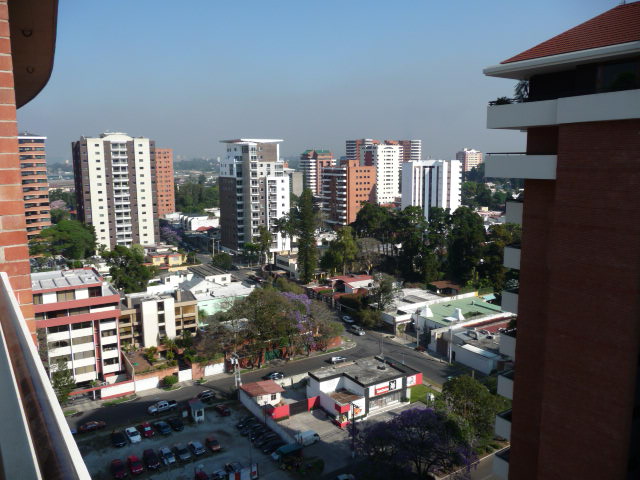
A view from our roof. This zone is full of new high-rise apartments.


This coming week we will be involved in Zone Conferences which will take us to several new areas. Attached are some pic we’ve taken during some of our travels.

Sunday, March 25, 2012

Our mission wheels - brand new Rav4. It's cruel to send a nice new car out on the roads here. After 18 months on the roads of Guatemala it will require a full chassis transplant. One of the favorite tricks is to put large speed bumps in an otherwise open road, with no warnings. And most of the time they are not even painted. But the local style of driving trains you to be constantly alert so you see them - most of the time. We have already passed two or three cases where someone's wheel just fell off while driving. 

I am developing a theory that the "wild west" (Libertarian?) style of driving here actually results in fewer accidents as we haven't seen many so far. Before I am done here I plan to write a book on the science of driving in Guatemala.
-- Ralph

Saturday, March 17, 2012

Dental Clinic and Orphanage


Some of the senior missionaries here with us are dentists who staff a  a  modern, well-equiped clinic in Guatemala City that was built by but not owned by the Church. They work on any missionaries with problems and also help lots of others not only in Guatemala, but they travel throughout Central America as well going into communitites and provide free dental services to whomever needs it. I am including a picture of a mural in the clinic that was made by the builders. If you look closely you will see a pair of missionaries with their Book of Mormon although there is no overt identification of them as it is a public clinic.


The clinic is next to a girls orphanage. These are kids that would otherwise be fending for themselves on the street. You will see pictures of the older girls making bread and one of our own, Sister Murray, demonstrating the proper way to knead bread by hand.