At Lake Atitlan

Thursday, July 26, 2012

Learning to Drive in Guatemala


Lest you think we are picking on Guatemala, I suspect that driving is much the same in most of Latin America and other developing areas. So what I describe here may apply in many parts of the world.

When a North American first sees traffic on the roads of Guatemala it probably looks like chaos. But we have found that there actually are rules – just different ones from what we are used to. And once you get used to them, it is not so bad and there may actually be some advantages.

There are two main factors that contribute to this automotive experience: (1) The way the roads are designed (or maybe not designed) and (2) the fact that there is virtually no law enforcement.

First the road system. If you have been to Salt Lake City and seen the wide, square roads laid out true to the compass, you will not see that here! Some of the roads are laid out close to compass directions but it appears to be pure chance when they are. Still, in most of the cities and towns, the roads do follow a grid pattern, just not a very careful one. Driving the side streets is not too challenging except for the prevalence of one-way roads without much apparent rhyme or reason as to why they go the way they do. Another challenge is that there are often no street signs identifying what street you are on or are approaching, and which cross streets are one-way. We often simply try to make a turn until we see that everyone is coming towards us!

The real challenge is on main thoroughfares. This country has an aversion to left turns. Not to say there aren’t any but they are so rare as to be a novelty when you do see one. You never realize what a great invention the left turn is until you don’t have them. Most of the main highways and boulevards are divided. Now imagine what happens if there is a divider in the center of the roadway and no left turns. That’s right – you can’t turn around! This is fine if you are just passing through, but if you are going shopping, for instance, even if the store is on the right side so it is easy to get to, you can’t get back home!

Now the problem is solved somewhat by providing an occasional turnaround. But they can be very scarce. We have found some roads where you literally have to go for miles before there is an opportunity to turn around. So we just don’t go shopping at those places because it is not worth the trip. I wish I could calculate the extra gas used and time wasted simply because you can’t turn around quickly.

Another challenge for the new arrival, which we all are at some point, is the lack of helpful signage. There are some signs, indicating, for example, “the airport is this way” but once you turn down that way, don’t expect any more help such as “arrivals over here”.  Probably the most important intersection in the country, where the Pan American Highway crosses the road from Guatemala City to the coastal plain has absolutely no signs indicating where it goes or how you get there.

The Pan-American Highway, as it goes through Guatemala City, has an interesting challenge of unmarked exit only lanes. You can be driving along on what appears to be a normal through lane and suddenly you are on the other side of a divider taking you who knows where. They are hard to see coming because of the heavy traffic you are in. You have to learn these by trial and error.

So to get to someplace you have never been, studying a map ahead of time helps some, but you are almost surely going to miss some turns and get there by trial and error, simply because there are few clear markings of crossroads and no directional help getting around.

Now for the rules of the road: I’m sure somewhere there are lots of traffic laws carefully deliberated and written out by legislators, probably much like we find in the US. The Guatemalan police are simply not set up to enforce them so the drivers make up their own rules of the road. As long as you don’t hit anyone you have lots of leeway. For example, there is no speed enforcement, so you can drive as fast as you want! I like that when on the open highway. Here are some of the rules as we have learned from observation:
• The bigger you are, the more right of way you have. At the top of the food chain are the trucks and buses; pedestrians are at the bottom. Here pedestrians have to learn to be very observant, light on their feet, and weave through traffic if there is no stop light.
• Stop signs are treated like yield signs at home. If no one is coming, keep going or you may get rear-ended!
• Turn signals are used by maybe 25% of drivers. The usual way you find out that the bus next to you wants your lane is when he starts driving into it.
• Vehicle lights are optional. We have been out at night and have seen trucks, buses and motorcycles driving with no tail or brake lights. Especially fun after dark and in pouring rain. Of course there are no safety or emission inspections.
• Speaking of emissions, all of the emissions saved in the US by spending billions of dollars on special equipment are probably totally offset by just the output of this country alone. Just think of all the old cars, trucks and buses that may have never seen a tuneup and are now in need of  a ring and valve job. We always keep our A/C on recirculate so that the smoke doesn’t come into the car. Now multiply that by the rest of Latin America, Africa and Asia! You see why what North America and Europe do to curb emissions is not going to have any global effect as long as the rest of the world has no similar controls.
• Motorcycles and scooters are all over the roads, swarming like flies, and apparently have only one rule – you can drive wherever you think the motorcycle will fit.

The net effect of all this is to create a driving environment that requires constant alertness (although we occasionally see people texting in traffic, usually going about 20 MPH slower than everyone else). In the US, we put up so many safeguards that it is easy to drive along, not paying a lot of attention to what others are doing. Not so here. As we first got into this driving environment we expected to see accidents every few blocks, but, interestingly, it seems that we see fewer accidents here than we did at home. I think the requirement for drivers to be alert may actually contribute to safer driving!

If you are the kind of driver that blows a gasket when you get cut off, don’t bother driving here. This is a libertarian driving environment where it’s every man for himself. If you let 20 feet open up between you and the car in front, someone next to you will probably want to fill that space. There is no point getting angry at other drivers or you will be angry all the time. Just realize that you have to be assertive like they are and go out and fight for that patch of road in front of you. After a while you learn the game and find that it’s not so bad. I just dread the day when I have to try to adjust to US driving rules again!

Sunday, July 22, 2012

We'll Go Where You Want Us to Go


When I was a young missionary there was always a lot of discussion about the different areas we could be assigned to live and work in. The plusses and minuses of each one were frequent topics, and opinions were given about the best and worst areas to be in. Those areas that were considered most undesirable were called “holes” as in “I hope I never get moved to that hole.” So what constitues a “hole”? The most frequently cited factors were weather, usually the heat, primitive living conditions in a small town, distance from city life, and the hard-headedness of the people. I suppose each missionary had his or her own list of most dreaded “holes”.

Of course, our ideas about how bad these places were arose from stories that others would tell. And the bad reputation was often proven to be just someone else’s opinion. One man’s hole can be another man’s heaven.

I spent some time in a couple of areas that might have been on many missionary’s hole list, and enjoyed them both. My second area was a small town, far from the capital city, in a hot and dry region of Guatemala. I was lucky enough to be there during the hottest time of the year which is March and April in this region. You might wonder why the summer months wouldn’t be hotter. The reason is that the rainy season runs from May through October and the almost daily clouds and rain result in cooling off in what would otherwise be the hot part of the day.

Any way, it was plenty hot there. We would drink several soda pops daily (that was before bottled water became fashionable) to keep our cools. And it was so hot in the afternoons that we would have no appetite at lunch time, except for an occasional milk shake. Instead we would usually head home for a cold shower (hot water was not needed here). But inspite of all that we had many enjoyable times and experiences there and it was in no way miserable.

As the rainy season began, our mission president thought I deserved to go to one of the rainiest spots in the mission, on the coast. This was another small town, with no particular claim to beauty, remote from the glamour of the city, where we had heavy rain daily and I experienced humidity like I never had before. It’s that kind of humidity where you kind of feel like you are swimming through the air. Sounds pretty miserable. But this turned out to be one of my most enjoyable areas! We learned to cope with the humidity, finding that our bodies adapted to it, sort of, after a short time living there. I met some of the most enjoyable and memorable people of my mission there.

As time went on I was sent to more temperate climates (as the tropics go, that is). I held out hope that, before finishing, I would be returned to the wonderful climate of my first area, in Guatemala City. So with every change came the double-edged sword: it could be better, or it could be worse. As it turned out, I never returned to work in Guatemala and spent the last 15 months in the more tropical climes of El Salvador.

But until I was in my last area and knew I would not be transferred again, there was always the nagging dread that I might be sent to my own personal hole of holes, as I had created it in my head: the town of Escuintla on the coastal plane of Guatemala.
Escuintla is only about an hour from Guatemala City but it is 4000 feet lower in altitude and so it has a hot, muggy coastal climate. It is the largest city on the coastal plane. I actually spent a couple of days there on a temporary assignment. Escuintla began as a transportation hub and rail center between coastal ports, the population center around the capital city, and the coffee, banana, and sugar growing and processing areas on the coastal plane. It was considered the most uncomfortable climate in the country. The people had the reputation of being the hard-headed, hard-living, hard-drinking types you would expect to be around transportation and processing enterprises. The Church was struggling to get a foothold there. The two branches in town were weak and new members were hard to find and keep. To top it off, the town had the appearance, kind of like our gold rush towns, that it had been thrown together in a hurry without any thought toward planning or esthetics. In other words, it was just mud-ugly!

Once I was in the area that I knew was my last, I was somewhat disappointed not to have returned to Guatemala City but comforted with the thought that I had avoided Escuintla and the other “holes” that I might have been sent to.

Then last November, we received our call to return to Guatemala! I thought “Now I will be able to spend time in the perfect climate of Guatemala City!” And we have, for 5 months.

But our president knows we need to be somewhere where we can contribute more. He thought a lot and fasted and prayed to know where we should be. Where could we most contribute to the strengthening of the Church? The mission district that is closest to qualifying for becoming a stake, with 5 strong branches, is (drumroll): Escuintla! And so about August first we go to Escuintla where we expect to spend our remaining 13 months. But this time we have a car and air conditioning! Many photos will come in later posts.

Friday, June 15, 2012

Three Months In


When people ask us what our assignment is, we always say “to do whatever the mission president asks us to do” because a lot of what we do is made known to us in a call from him. Ralph acts as secretary to the mission presidency so there are quite a few miscellaneous, ad hoc assignments that we are given. The president has two counselors and an executive secretary who are Guatemalans, but who are also employed full time. So, unlike them, We are available at any hour to carry out whatever task is needed at the time.

If you have never been close to the administration of a mission of the Church, you probably have no idea of the many responsibilities on the shoulders of a mission president. The obvious part of his job is the supervision and leadership of approximately 200 young missionaries, men and women in their early 20’s, scattered in cities and towns over an area of thousands of square miles. He is responsible for their safety, health and wellbeing, as well as training them in their duties and tracking their performance. He interviews each one personally and individually every few months. Training meetings take place approximately monthly for every missionary and the president determines what training is to be given. He is also available constantly to provide cousel and  handle personal problems which can and do come up unexpectedly at any time. For example, one time when I was driving home with the president from an outlying area, he took a call from a pair of sisters who were in tears dealing with discouragement and difficulties getting along with each other. He lovingly and  patiently took about 20 minutes to talk with each one and help them put their troubles in perspective.

To help with the administration of the missionaries, the president has four secretaries and two assistants, chosen from among the young missionaries. These assignments turn over every few months. The assistants are chosen from among the very best of the mission and are his “right hand men” who handle much of the routine supervision and training functions. The secretaries handle record keeping, clerical and administrative items, such as tracking key performance indicators weekly, and bringing in new missionaries and sending off those who have completed their service, which happens every six weeks. One of the secretaries keeps track of the finances, such as getting funds to cover living expenses out to each one monthly. The funds come from donations made by their families and others back home, and may include funds from the missionaries themselves saved up before leaving home.

The part of a president’s duties that are not as obvious is the administration of branches and districts. Branches are small congregations that are in a developmental stage, with insufficient membership to be largely self-sustaining. They are grouped into districts and the mission president presides over all of these units and their members. In our case, we have three districts with six to nine branches each. In time, these units will grow and develop into larger and stronger entities (wards and stakes) that can largely govern themselves. While they are still developing they have significant needs for training and direction.

To assist the president with the administration of these developing units, the president has two counselors and possibly two secretaries. These men are usually local members who are employed and raising families, so are available for part-time service, much like the local leaders in branches, districts, wards and stakes throughout the Church. The president can delegate much of the supervisory responsibility to his couselors, but some things he cannot delegate, and, as always, the buck stops with the mission president.

And so we spend most of our time helping with some of his many responsibilities. Our primary responsibilities are:

1. Helping the young men and women of the branches decide if they want to serve as missionaries and helping them with the process of getting ready to serve, which includes getting medical and dental exams and passports. The large majority of them will serve in other countries. We are currently working with a pool of about 50 young men and women, ages 18-25, who are potential future missionaries from all the branches.

Future missionaries entering their personal information for their recommendations to serve
2. Encouraging and helping the non-English-speaking missionaries who are currently serving to study with their English-speaking companions and learn English to the extent that they can pass a proficiency exam before going home. This is a tremendous help with their future studies and work and to help them raise future families who are not burdened with poverty. We attend their training conferences to continually encourage them and recognize those who are progressing.
Sisters from Ecuador and Nicaragua going home after 18 months of service

3. Jolene is also the mission historian, compiling an ongoing document of performance and events.

A fair amount of our time is spent on the road. We put over 5000 km on our vehicle over the first three months, traveling to all parts of the mission.

And we have just been given a new assignment: To move from Guatemala City to one of the districts to help it grow and prepare to become a stake! More on that later.
District conference at Solola - many of these people are indigenous and  continue to wear traditional clothing


Childrens' choir on the stand at the Santa Lucia District Conference

Members heading home after conference


One of Guatemala's completely modern shopping malls

Elder Amado of the Seventy teaching the young missionaries

Enjoying a day off

Thursday, April 26, 2012

Our Day in Antigua


Going to Antigua for the Semana Santa (Easter) was an interesting and beautiful experience. We left Guat City on a small bus at 6:30 am. We traveled with about 18 other Senior Missionaries. The drive took about 45 minutes getting us to the hotel ­­­­­­­­­­Santo Domingo in time for breakfast. The food was good but slow in the service… We had a tour guide with us for the day, that was good except when he decided to go off on his own?!? Its really interesting watching the people create the colorful carpets in the center of the roads. The most beautiful and colorful ones use colored sawdust. They set down forms and proceed to fill them in with various colors of sawdust. The end results are most beautiful, as you can see in the pictures.

The roads are all cobble stone, all hand created many hundreds of years ago. I love the effect but the walking takes some practice. The carpets are created on top of these stones, when completes the Catholic processions walk over them. They have many processions during the Holy week so many people are involved in making the carpets, over and over again. I was touched by their dedication and devotion to this form of honoring the Savior.

The processions are made up of people who pay a lot of money to participate in them. They carry these platforms that are made our of hard woods, they must weigh 100’s of pounds each. The people place them on their shoulders, the most we counted on each side was 80 men. The platforms have depictions of the Christ carrying his cross, Some have other depictions of Christ and Saints. The ones that have Mary are carried by women. They are beautiful, but they left me with a since of sadness because they were all about the darkness of Christ's death. We were told that on Easter Sunday they have a smaller procession celebrating the resurrection. I would love to see that part one day. Also the platforms are followed by men and young boys dressed in purple robes. The little ones are wonderful to watch, they are so cute. Some were so small they fell asleep on their papa’s shoulders.

Over all we had a great experience, we did have the loss of one wallet and a hand bag got slashed in the crush of people. If ever you get the opportunity to go Do Not carry valuables with you. Remove your watches, jewelry and split up your money putting it in different places on your body!


After lunch we loaded up onto the bus and headed home, all tuckered out but happyJ!

Saturday, April 14, 2012

Opportunities for Improvement

One of our several responsibilities here is to help the Latin missionaries learn English. There is a formal program of 25 lessons that they can work on with their English-speaking companions as part of their daily study. The program is optional but naturally we encourage all to participate. If they do well, they can take a test after completing all the lessons. The test is audio and verbal over the computer. If they do well on the test, they get a certificate attesting to their English proficiency which will help them with future school and employment opportunities. Being bilingual can greatly increase their earning ability.

About half of the missionaries in Guatemala come from all over Latin America. The photo here is of Elder Miguel Hernandez from Sonsonate El Salvador. He is taking the test at the chapel in Jocotenango Guatemala using our laptop and a cellular Internet link. I am sure from talking with him that he will do well on the test. He makes the 5th one we have seen take and pass the exam this month, all from a group which is going home next week. How satisfying it is to see these young people reach this goal. Our first major success!

Elder Hernandez acing his English Exam

Members in Jocotenango have the added bonus of their own avocado tree (at right)
Another way the Church helps its young members in developing areas is by providing loans to allow them to get training and schooling that they could never qualify for on their own. The Perpetual Education Fund, as it is known, is funded from voluntary donations that members make, apart from tithing and other contributions. It allows these young people to prepare for good-paying jobs and provides a way out of the cycle of poverty for them and their future families. As they repay their loans, funds become available to help others. This is modeled on the Perpetual Emigration Fund which provided loans to help people emigrate to Utah in the 19th century.

Saturday, April 7, 2012

Revelation


This past week we had zone conferences. This is where the missionaries gather periodically in groups of about 50 to receive instruction from the mission leaders. We had a meeting each day, Monday through Thursday: one in the highlands, one on the coast, and two in the southern suburbs of the Capital. Each session is essentially the same, with presentations and training from the president, his wife, and the two assistants to the president (positions which rotate periodically among the best of the young missionaries). We had a small part at each meeting to talk to the native Spanish speakers about learning English during their missions. Each day was almost the same as each other, except for the last.

Sister and President Brough get ready to dive into the largest guacamole nacho plate I have ever seen (we helped them out).

The Patzicia Stake Center. Patzicia is a small city in the Guatemala Highlands.
Our President’s wife is a very sweet young (to us) lady. The missionaries are all fond of her. We learned a few days ago that she had been one of the young dancers in the original Footloose movie with Kevin Bacon. As she was finishing up her message, she stopped and teared up as the thought came to her to ask a question unrelated to her presentation. The mission has a directive that all the missionaries will unite in prayer at 8:00 AM, wherever they are, for the safety of one another. Sister Brough received revelation that this zone had several who were not in compliance. She asked them to raise their hands if they were not remembering to pray at 8:00 AM. Quite a few hands went up, giving her the opportunity to ask them to commit to the practice. We all felt the spirit as we realized that she had been chosen at that moment to receive important intelligence that no one, other than the delinquent missionaries knew.

Sunday, April 1, 2012

Another Exciting Week


It has been another fun filled week for us, we are kept pretty busy most of the time. Which is important for me especially as I have a tendency to get home sick if I don't have anything to do. Last Saturday we drove down to San Jose to go to the beach. We never did find the hotel where we could rent a room for a few hours. It was SO crowded! Hundreds of people everywhere so we just walked on the beach for a little while then made our way back to the city. You would not believe that town! To start off the streets are very narrow with more motorcycles and scooters than I have ever seen in my life! And to top that off there were about 5-6 semi trucks full of gas mixed in the mess. We couldn't go very far that's why we couldn't get to the hotel. The beach front is lined with tons of small shacks mostly offering food, drink, beach clothing, etc. some houses. You could drive down little alleys where they had signs where you could park your cars. We went down one and this old beach bum started to direct us into a parking spot. He moved a motorcycle out of the way for us! It was at least a 5 point maneuver to get the car parked. He then introduced us to the proprietor of the establishment who showed us where we could change. That was interesting, they opened doors into these little rooms with a small bed. We both looked in and decided they were bug traps! No way was I going in one of them and never sit on the beds! Ohhh willies! 
We walked a few feet to the very wide and beautiful beach that was covered with people and trash... Apparently they don't ( ever) clean the beach nor did I see any trash cans. I thought of the video going around about the trash in the pacific ocean over 2 miles wide and I realized the trash isn't coming from the US as much as it is coming from these 3rd world countries. So sad because it was a huge wide black sand beach. We are going to ask our new friends that lives out there what is the best beaches to visit next time.
It was cool to drive in the country and see all the different areas. It's really beautiful in most areas, again the sad part is the trash on the sides of the road. In the city they clean it up but not in the country. We passed many sugar cane fields. It's cool, they let the fields grow to maturity then cut it before the rainy season. They fill up these huge trucks that takes it to the sugar factories. It is the countries biggest export. The canes will produce for five years then die off. They will then replant the fields for another round. 
The coconuts are also being harvested right now, they have tons of road side fruit stands filled with coconuts, mangos, watermelon. The watermelon is the best ever! Tastes like candy! Oh they also have lots of bananas! It's funny in the stores you will find local pineapples and then some from Hawaii, of course the local ones are to die for. Not sure why they bother to ship in from Hawaii??? It's a mystery.
We drove past a volcano but it hasn't been active for over 300 years, but neat to see.
We had a special experience this week, eith the sisters of our mission during the Sisters Conference. All the sister missionaries from our mission met and had meetings with a catered luncheon. I was asked to talk about living through the hard times of life and returning to out Heavenly Father with honor and enduring to the end. Dad translated for me but I gave my testimony in Spanish! It was hard because I had lots of new words I needed to learn :) several sister missionaries gave their testimonies expressing their love for the Lord and the gospel, and they all spoke about how hard it has been for them to adjust to their new lives here. They made me realize how blessed I am, I can write or call home anytime I want and I can even go home if I need to. One sister hasn't heard from her family in 6 months! Yes I am blessed to have all of you and your prayers, emails, and calls. Thank you we love you all every day!
I think of you all of you always and truly look forward to your emails.
The mission office staff at the president's apartment

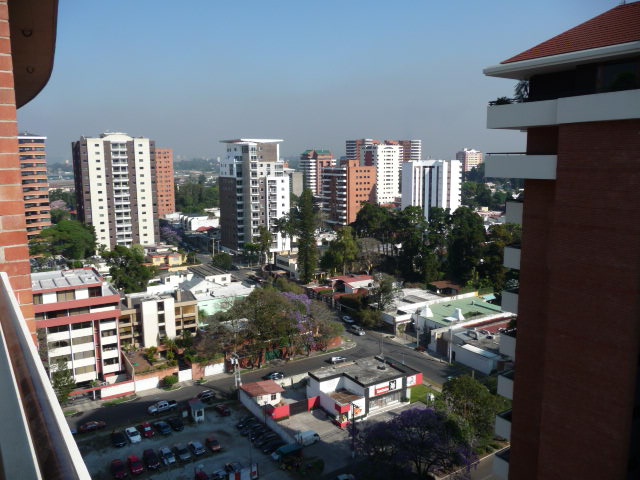
A view from our roof. This zone is full of new high-rise apartments.


This coming week we will be involved in Zone Conferences which will take us to several new areas. Attached are some pic we’ve taken during some of our travels.